Pages

Showing posts with label J. R. R. Tolkien. Show all posts

Tuesday, April 27, 2010

Great Friendships

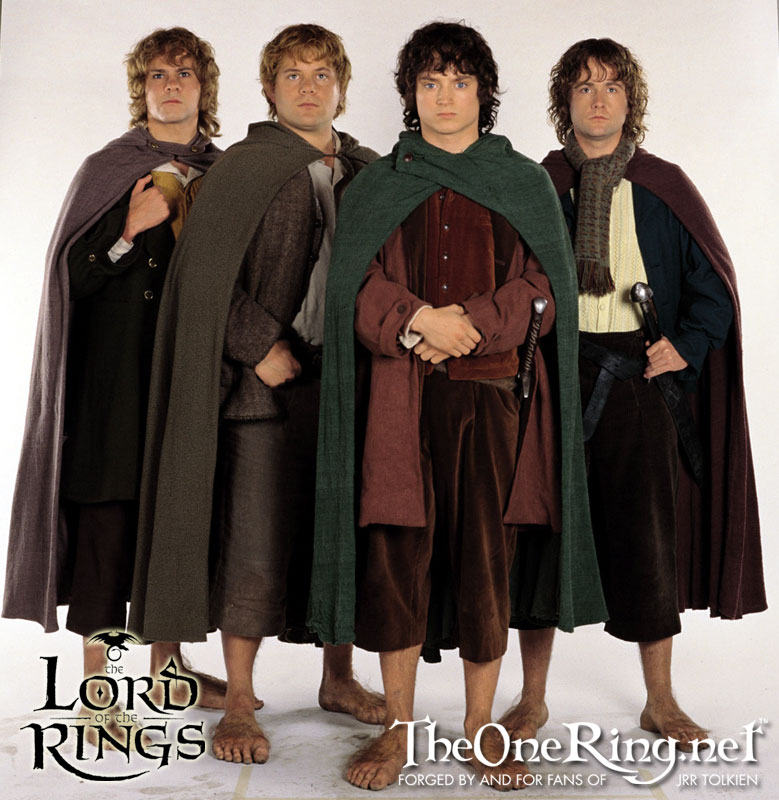
One of the virtues that runs through J. R. R. Tolkien’s masterpiece, The Lord of the Rings is the virtue of friendship.  It is obvious to anyone who has read the story that Tokien put a lot of value in the positive impact friendships can have in our lives.  One of the places this value is seen is during the selection process of people who will make up the fellowship.
‘But that will leave no place for us!’ cried Pippin in dismay. ‘We don’t want to be left behind. We want to go with Frodo.’

‘That is because you do not understand and cannot imagine what lies ahead,’ said Elrond.
‘Neither does Frodo,’ said Gandalf, unexpectedly supporting Pippin. ‘Nor do any of us see clearly. It is true that if these hobbits understood the danger, they would not dare go. But they would still wish to go, or wish that they dared, and be shamed and unhappy. I think, Elrond, that in this matter it would be well to trust rather to their friendship than to great wisdom. Even if you chose for us an elf-lord, such as Glorfindel, he could not storm the Dark Tower, nor open the road to the Fire by the power that is in him’ (The Lord of the Rings: The Fellowship of the Ring; p. 310 ; emphasis added)

I would suggest that the desire for good strong friendship is a desire each one of us possesses. We long to have people in our lives that we can count on through thick and thin. People who we know will be there for us no matter what happens. People who we can love, serve, and with whom we live life.

Let’s face it, this world has hardship and pain in store for us. I am willing to be that if we received right now the detailed accounting of the rest of our lives each and every one of us would be afraid to continue. Our future holds the death of loved ones, the slow decay of our bodies, money problems, relationship issues, and various other struggles. The future is a scary place.

We can come up with answers and theories for all these various problems on this side of our lives, before we go through those trials, but those theories mean little once we get there. C. S. Lewis wrote the book The Problem of Pain which gave a logical and thought out answer to why a loving God allows pain and suffering in this world. Those answers provided little comfort as he dealt with his wife’s death and authored A Grief Observed.

What will get us through the through the tough times that lie ahead is not just wisdom and truth, but also the love and encouragement found in friendships. In the dark times in our lives what we need most are not answers to questions but companionship. We need people willing to come alongside of us and offer a word of encouragement, to serve us in our needs, and to show us they love us when the loneliness threatens to overwhelm us.

This type of companionship is to be found in the church.  Consider what the Bible says about what our relationships with other Christians should look like:
Pay all your debts, except the debt of love for others. You can never finish paying that! If you love your neighbor, you will fulfill all the requirements of God’s law (Romans 13:8; NLT).

Follow God’s example in everything you do, because you are his dear children. Live a life filled with love for others, following the example of Christ, who loved you and gave himself as a sacrifice to take away your sins. And God was pleased, because that sacrifice was like sweet perfume to him ( Ephesians 5:1-2; NLT).

Think of ways to encourage one another to outbursts of love and good deeds. And let us not neglect our meeting together, as some people do, but encourage and warn each other, especially now that the day of his coming back again is drawing near (Hebrews 10:24-25; NLT).

We know what real love is because Christ gave up his life for us. And so we also ought to give up our lives for our Christian brothers and sisters. But if anyone has enough money to live well and sees a brother or sister in need and refuses to help—how can God’s love be in that person? (1 John 3:16-17; NLT)

God wants us to love each other.  So our church families should be refuges from the divisions, gossip, and hatred that plagues the world.  Yet, I believe that within this big picture we need a group of 5-10 fellow believers that we are intimately connected with, people we know have our backs. That is how we are going to make it through life.

God could have revealed to us all the secrets of the universe and given us all the wisdom we need to answer any question that came up as we live our lives. Instead God provide us with the church and from within the church He has provided us with friends. Great wisdom and knowledge are not the only provisions we need to get through this life, we also need great friendships.  I hope that you have a few.

Monday, March 01, 2010

Walk the Difficult Road

Originally posted Thursday March 24, 2005

It is no secret that I love The Lord of the Rings.  It has many themes woven into the story that apply to our lives as Disciples of Christ.  One of those themes is the theme of the dangerous and difficult road.  We would like for our lives to be a bed of roses, but reality tells us a different story.  Jesus doesn’t allows lead us by the safest road, but He does lead us to where we need to be.

“None here can do so,” said Elrond gravely.  “At least none can foretell what will come to pass, if we take this road or that.  But it seems to me now clear which is the road we must take.  The westward road seems easiest.  Therefore it must be shunned.  It will be watched.  Too often the Elves have fled that way.  Now at this last we must take a hard road, a road unforeseen.  There lies our hope, if hope it be.  To walk into peril—to Mordor.  We must send the Ring to the Fire.” (The Fellowship of the Ring, p. 299)

In life the best road to take is not always the easiest road, often we must take is the hard road in order to live the life God created us to live.  Regardless of the peril that road may have, it is the road we must travel if it is the road Jesus picked for us to walk.  We can no longer be content to seek the easy way, for Christ is beckoning us to rise up to the challenge of following Him.

In Rivendell, at the Council of Elrond, the free people of Middle Earth had to decide what to do with the Ring of Power.  One suggestion was to take the Ring to the Ocean and cast it into the deep so it would be lost forever.  The other option was to take the Ring to Mordor and to cast it into the fires of Mount Doom.  To go west seemed easy and the road to Mordor was filled with dangers, but the only way to make sure the Ring is gone forever was to go towards the enemy, rather than away from him.  The road to Mount Doom was the hard road, but it alone was the path to victory.

Jesus told His disciples; “When the world hates you, remember it hated me before it hated you.  The world would love you if you belonged to it, but you don’t.  I chose you to come out of the world, and so it hates you” (John 15:18-19; NLT)

Jesus just told His disciples to live lives of obedience, to produce fruit, and to love each other, for then the world would know they were His disciples.  It is that context that Jesus reminded them that this road He called them to travel would not be easy.  People would hate them for how they lived and what they how they served people.  For the disciples to follow Jesus meant to travel a hard road: the road of hatred and persecution.  Yet, it was by traveling this road that they were able to discover the life God has called them to live.

It is easy to remain part of the world, to offer up nice ideas instead of the truth, to be ”tolerant” rather than remain steadfast in our convictions, and to be nice rather than to love.  The easy thing is to live a life that will make people like us, but for that to happen we have to be like them.  The way of Jesus leads us away from the world and towards God, which shines a light upon all those around us.  We are hated because people don’t like their lives exposed by the light of God’s truth and love.

Christianity is not easy.  It is not the easy way to live life nor is it the easy way to heaven.  Jesus, as well as the rest of the New Testament,  taught that the Christian life would be filled with hardship and trouble.  Christians have not been promised an easy life.

Though it is not easy, following Jesus is the way we must travel if we are going to have a relationship with God.  It is The Way God has provided for us to have an eternal relationship with Him.  There is no other way to God except through the person of Jesus Christ.

Just like Frodo we are called to travel the difficult way, for it is through this journey that we able to become our true selves. 

There is one difference between the word we are called to travel and the journey Frodo took to destroy the Ring.  The road Frodo was to travel no one could see the outcome, they did not know if it would end with the destruction of the Ring.  While we may not know every twist and turn that of the journey we do know that they journey will end successfully, because of Jesus we can know that one day we will be able to spend eternity with God.  What better motivation can there be to keep moving forward?

Saturday, December 19, 2009

Value People

Originally posted Friday December 10, 2004

"Anytime you devalue people, you question God's creation of them." ~ Coach Bill McCartney, founder of Promise Keepers

Samwise Gamgee is the constant companion of Frodo in The Lord of the Rings. Sam chooses to follow his friend and master, Frodo, into the dangers of Mordor. From Sam's behavior we know that there is a lot of good to be found in him: friendship, courage, being prepared, and even simplicity. J.R.R. Tolkien, the author of The Lord of the Rings found Sam to be the Hobbit which he liked the most. In many aspects Sam would be a character worth imitating.

I am afraid that instead of telling you how you should be like Sam, I am going to remind you not to be like him. J.R.R. Tolkien, as he wrote the famous trilogy, would write letters and send manuscripts to his son Christopher who was serving in the Royal Air Force during World War II. In one of these letters Tolkien wrote, 'For myself, I was probably most moved by...and the tragedy of Gollum who at that moment came within a hair of repentance -- but for one rough word from Sam."

Though the scene that Tolkien refers to in the letter doesn't appear in the movie, at least to my recollection, the thought was still there. In the movie version Sam continually calls Gollum names like Stinker and never wanted to trust him. Frodo on the other hand, reached out to the former Ring holder Gollum, and even questioned Sam's treatment of the wretched creature.

I am afraid that we often treat people struggling with sin the same way Sam treated Gollum. Sam could see that Gollum had been corrupted by the power of the Ring and therefore that Gollum couldn't be trusted. Sam also made sure Gollum knew exactly what he thought about him by calling Gollum names. In other words, Sam put labels on Gollum in order to deal with the creature.

When we behave like Sam, we became a hindrance to people who want to repent and change. That is precisely one of the sins Jesus condemned the Pharisees, the religious leaders of his day, for doing.

{42} But how terrible it will be for you Pharisees! For you are careful to tithe even the tiniest part of your income, but you completely forget about justice and the love of God. You should tithe, yes, but you should not leave undone the more important things.

{46} Yes how terrible it will be for you experts in religious law! For you crush people beneath impossible religious demands, and you never lift a finger to help ease the burden.
(Luke 11:42 and 46; NLT)


In Luke 11:37-52 Jesus criticizes the religious leaders of the day. They may have been good religious people, but they never lifted a finger to help those in need, especially those struggling with sin. They were passionate about theology but not compassionate towards people. The Pharisees would name call and blame before they would help. That is exactly what Sam does with Gollum, and sadly that is what we do to people who need our help as well.

Here is the bottom line: When we discover sin in someone else our first reaction should be, needs to be, to reach out to them in love. It doesn't do them any good for us to call them names or even give them new rules to follow, which does nothing to relieve the guilt and shame they have. Let compassion be your guide and always remember the forgiveness and compassion God has given to you through Christ Jesus.

Monday, October 26, 2009

In Possession of Sin

Originally posted on Friday, September 24, 2004

Take a moment and think about what John Maxwell and Jim Dornan wrote in their book Becoming a Person of Influence; “Slaves is the right term to describe people who lack integrity because they often find themselves at the whim of their own and others’ changing desires” (p. 32)

The movie version of The Lord of the Rings has made J. R. R. Tolkien’s story accessible to thousands of people who would never bother with actually reading the story. One of the characters that people seem to identify with is the character Gollum. Gollum is a pitiful creature because he has been corrupted by the power of the One Ring. The Ring consumes Gollum’s life, and there is nothing he can do to break free from its power. Colin Duriez in The J.R.R. Tolkien Handbook describes Gollum like this: “In The Lord of the Rings a once-hobbit who bore the marks of long centuries underground guarding yet possessed by the One Ring which he called ‚ ‘my precious’, and which he had deluded himself into thinking was a birthday present to him” (p. 106). The possession of the Ring had changed Smeagol to Gollum, from a Stoor Hobit to a pitiful creature. The Ring may have granted Gollum unnatural long life, but it also physically changed him. Worse than the physical change was the control the Ring had on Gollum’s desires and dreams. They were twisted and corrupted so much that all Gollum could think about was to regain possession of his “precious”.

I think sin has very similar effect on us. Unlike the Ring sin will not prolong our lives, in fact God promises us that sin brings about death. It will also not physically change us from human into something less human, but sin will cause us to behave less than human (true humanity is found in Jesus). It will twist our desires and dreams into things that are evil and wicked. Sin will make us think that the only thing that will make us happy is the evil behavior that we are involved in. Sin consumes and corrupts us, which keeps us from becoming the people that God created us to be.

Consider what the apostle Paul wrote about the effect of sin on the lives of people:
Therefore God gave them up in the lusts of their hearts to impurity, to the dishonoring of their bodies among themselves, because they exchanged the truth about God for a lie and worshiped and served the creature rather than the Creator, who is blessed forever! Amen. (Romans 1:24, 25; ESV)


The apostle Paul in Romans 1:18-32 is very clear about the corruption that takes place because of sin’s presence in our lives. When we are in the possession of sin it is impossible for us to be who God created us to be. The reality is that sin twists our hearts and souls making us corrupted forms of the people God created us to be.

I want you to understand the vile effect that sin has on our lives. Sin not only corrupts us, but it also controls us. It makes us long for the things that not only will not make us happy and content, but will ultimately lead to our destruction. Sin is not something to mess with; because it will take control of our lives, and in the end destroy us.

I know that this sounds dark and depressing, so I will not end on that note. Instead I want to give you a glimpse at light at the end of the tunnel. The apostle Paul wrote this about the power of Jesus’ resurrection in our lives: Therefore, if anyone is in Christ, he is a new creation. The old has passed away; behold, the new has come (2 Corinthians 5:17; ESV).

The Good News is this: Jesus has the power to restore! He can breathe life back to the dead. He can heal the twisted and evil soul that we have. We don’t have to be possessed by sin because Jesus, through His death and resurrection, has rescued us from sin and death. This Good News is for all who are chained by the power of sin. We need to remember that freedom is found in Jesus!

Tuesday, January 13, 2009

Fade Reluctantly

The last few days I have been re-reading The Fellowship of the Ring. If you are familiar with the story you know that a hobbit by the name of Frodo Baggins has come into the Ring of Power and it is his responsibility to take the Ring to Rivendell, to the home of Elves, so the Ring’s fate could be decided. On that journey, poor Frodo, is stabbed with Morgul-knife which, if it is able to pierce the heart, able to turn a person into a wraith.

Fortunately for Frodo, he is pierced in the shoulder, and is able to hold out until he reaches Rivendell and help. A splinter of the knife is removed from the wound, before it was able to reach Frodo’s heart. This is what Gandalf the wizard says to the hobbit; “Don’t be alarmed! It is gone now. It has been melted. And it seems Hobbits fade very reluctantly. I have known strong warriors of the Big People who would quickly have been overcome by that splinter, which you bore for seventeen days.” (The Fellowship of the Ring, p. 248)

Why was Frodo able to hold out, when bigger and stronger people would have been overcome? I think that answer lies in the Shire, the home of the hobbits. The Shire is a good place and the hobbits are good people. Evil was not part of their existence. It also explains why the Ring had such little effect on Bilbo Baggins when he possessed it, and why Frodo was able to resist its evil so long as well. The goodness of their home acted as a shield against the assault of evil from the Enemy.

So what does this have to do with you and me? Remember, we too have an Enemy out to destroy us. We have all felt his assault of evil in our lives: divorce, tragedy, job loss, betrayal, and sickness are just a few weapons he uses to attack our hearts, to make us like he is: a God-hater.

What will get us through those tough times? The Church. It is the goodness and love we experience from other Christians that is able to give us the courage and the hope to hold out, no matter what evil may come our way.

If that is true there are two important things that we need to do. First, we need to be committed to a group of Christ-followers. We cannot benefit from the love, encouragement, and help of other Christians if we do not make the time to fellowship with them. Second, we need to do our part to love, encourage, and help other people when they are experiencing difficult times. It is the choice of individual Christ-followers to love and be good that make the Church a place of healing and hope. We have to make that choice to make sure it remains so.

When we are protected by the good of the Church, we will fade reluctantly when evil comes our way. Let us be committed to the Church, and being agents of good in this world.

Let us hold fast the confession of our hope without wavering, for he who promised is faithful. And let us consider how to stir up one another to love and good works, not neglecting to meet together, as is the habit of some, but encouraging one another, and all the more as you see the Day drawing near. ~ Hebrews 10:23-25; ESV

Friday, August 17, 2007

Using Our Free Will

“Freewill is an important theme in Tolkien, particularly the voluntary commitment to the struggle against darkness and evil, sometimes against all odds.” ~ Colin Duriez, The J.R.R. Tolkien Handbook: A Concise Guide to His Life, Writings, and World of Middle-Earth

In the stories of Middle-earth: The Silmarillion, The Hobbit, and The Lord of the Rings all characters who have to face the choice that will determine what side they are own. Take for instance the wizards of Saruman and Gandalf. Both were Maiar in human form (like angels found in the Bible), and both were sent to Middle-earth to help resist the evil of Sauron. Saruman and Gandalf had the same background and mission.

For Saruman there came a time when he thought the best idea would be to join the side of the Enemy. His desire to have the One Ring, to have the power it represented, was more than Saruman could resist. The powerful wizard chose power over the responsibility that he had been given.

Gandalf on the other hand remained true to his call. Even when the Ring was within his grasp he resisted because he knew the great evil that it represented. Gandalf had a choice in the matter, but he chose to resist evil rather than side with it.

There comes a time on the journey to destroy the Ring that Sam wonders about turning back, but he realizes that in the best stories the heroes continue to move forward, against impossible odds, even though they had the chance to turn back. Frodo and Sam did not have to go all the way to Mount Doom, but they chose to complete their mission.

I realize that Tolkien’s world of Middle-earth is fiction, but this theme found in Tolkien’s writing is a very important theme for us to understand. Everyday we are faced with the choice to move forward with God or move back and side with the enemy. It is certainly a choice I have faced throughout my life. It is not just the choice to sin, but it is the choice whether or not to side with the Enemy and abandon God. It is the choice to use the talents God has given me for His purposes or to use them for my own gratification. It is the choice to keep my eyes on the big picture rather than just the moment I am living in right now. Yes, I have faced the choice to leave the Christian Faith and to live life on my own terms. God has given me a say in the matter.

Each and every one of us has been given a choice by God. It is not about saying we believe in Jesus and going to church. It is about pledging our allegiance to God and to His purposes. Are we going to use the time, talents, and money God has given to us for His work? Are we going to move forward, living a life of holiness, even if the rest of the world persecutes us for what we believe? Will we chose to follow Jesus even if it seems hopeless to us?

God has not dictated the course our lives. God has created us with talents, allowed us to develop certain skills, and brought us through experiences that can be used for expanding His kingdom, yet the choice on how to use these great gifts God leaves up to us. He has given us the ability to determine whether or not we will follow His Son Jesus or to join the opposition work of the Enemy. That is the choice we have to make, and it is the choice which determines our eternities.

Thursday, February 15, 2007

Chosen By God

"'I do really wish to destroy it!' cried Frodo. 'Or, well, to have it destroyed. I am not made for perilous quests. I wish I had never seen the Ring! Why did it come to me? Why was I chosen?'

"'Such questions cannot be answered,' said Gandalf. 'You may be sure that it was not for any merit that others do not possess: not for power or wisdom, at any rate. But you have been chosen, and you must therefore use such strength and heart and wits as you have.'"
~ The Lord of the Rings: The Fellowship of the Ring by J.R.R. Tolkien

The Ring has a dark history. It had used different people in an attempt to get back to its master. Yet something happened the Ring had no control over, it had abandoned Gollum in hopes of being picked up by a goblin, but instead, at just the right moment the hobbit, Bilbo Baggins discovers it. There is a higher power at work than the force of evil.

In the long history of the Ring, only Bilbo gives it up by his own choice. All the other beings in possession of the Ring had lost it, and even Frodo, at the end, has it taken from him. Yet, in the choice of Bilbo to let go of the Ring makes way for Frodo to become the next Ring Bearer.

Frodo felt ill suited for the task which had to be done. He didn't believe that he had what it took. And Gandalf agrees. Frodo was not chosen because of his mighty talents, but because of the strength of his character. It was the same reason Bilbo was chosen before him. Gandalf urges Frodo to use the strength, the wits, and the heart he has to carry out the mission.

God has chosen every Christians for a task. Generically that task is to make God famous throughout the world; to proclaim His love and forgiveness to the nations. Specifically it is discovered as we walk with God each day.

To be honest we are ill suited for the task God has laid before us. We don't have what it takes to change the world. Just like Frodo, we look at ourselves and think we are not made for this type of work. The task is too big for us.

What God is interested in is that we use what He has given to us and leave the rest up to Him. We go about our lives believing that we can make a difference in the world in which we live. It might seem like we have no chance at making a difference, but God wants us to act like we will.

That is what Frodo does. He goes on this adventure as if it were possible for him to succeed, and God shows up to make it happen. To miss the theological content of The Lord of the Rings I believe misses the story Tolkien wrote.

Here is what we can take away from Frodo's journey. The job we have before us is huge and we are small in comparison. God wants us to live from the strength He has given to us and believe we can change the world. When we do this we then experience God in a whole new way. A way that is not possible from study and prayer.

9 He saved us and called us with a holy calling, not according to our own works but according to his own purpose and the grace that was given to us in Christ Jesus before time began. 10 Now, however, it has been revealed through the coming of our Savior Christ Jesus, who has destroyed death and through the gospel has brought life and release from death into full view. 11 For the sake of this gospel I was appointed to be a preacher, an apostle, and a teacher of the Gentiles. ~ 2 Timothy 1:9-11; ISV


God has chosen us. Even though we don't feel up to the challenge, if we go forward, He will experience His power as He carries out His plan for our lives and for the world.

Saturday, October 21, 2006

Finding Our Place in the Story of History


“The Gospels contain a fairy-story, or a story of a larger kind which embraces all the essence of fairy-stories…But this story has entered History and the primary world; the desire and aspiration of subcreation has been raised to the fulfillment of Creation.” ~ J.R.R. Tolkien; The Tolkien Reader


The heart of Christianity is a myth which is also a fact…It happens—at a particular date, in a particular place, followed by definable historical consequences…By becoming fact it does not cease to by myth: that is the miracle.” ~ C.S. Lewis; Mere Christianity


The power of story is great. It has the power to make us believe things that we never would have thought possible, to dream things that are bigger than ourselves, and to understand the desire of our hearts. For both Tolkien and Lewis it was story which gave real meaning to the world.

Story can take on many forms. For Tolkien and Lewis they were primary concerned with myth and legend. For our society today we are concerned with the visual stories on television and the movie screen. The reason these things are so seductive, the reason they pull us in is because they are able to show us glimpses of the life we were created to live.

One of primary thoughts John Eldredge puts forth in his books is that the stories that we love reveal to us the desires God has created in us. For example I love the movies Gladiator and The Magnificent Seven. Why? Because I long to have the courage that is displayed by Maximus and Chris (the leader of the Seven). I love The Last of the Mohicans. Why? Because I desire to be the one who rescues the Beauty from the hands of the enemy. God uses story to help us discover the longings of our hearts.

But the greatest story God uses, the one He used to reveal to us Himself, is History. History is the account of God working in this world. Notice how both Tolkien and Lewis recognize the importance of History. When we neglect the study of History, when we make stories just about us, we miss out on what God desires us to know. It is through the study and telling of History that we come face to face with the God who is seeking to redeem all of creation.

This idea of History as God’s story was very important to the first century Jew, and thus it needs to be very important to us:
This was Stephen’s reply: “Brothers and honorable fathers, listen to me. Our glorious God appeared to our ancestor Abraham in Mesopotamia before he moved to Haran” (Acts 7:2; NLT).
Stephen goes on to give a short account of History to illustrate that Jesus was indeed the One God promised long ago.
So Paul stood, lifted his hand to quiet them, and started speaking. “People of Israel,” he said, “and devout Gentiles who fear the God of Israel, listen to me” (Acts 13:16; NLT).
From that introduction Paul tells a summarized version of God working through History to bring salvation to people. Paul reminded the people of the Story they were a part of.

If we are going to reach people in this post-modern, post-Christian, and pagan age that we live in we need to return to Story. People are not going to be motivated to change because we can list 20 virtues for Christian living. Lives will not be transformed if we allow ourselves to be pulled into senseless philosophical or scientific debates. Change will only occur when people come to realize they have fallen into a story, and how they live determines what type of character they will be.

Wednesday, October 04, 2006

Making an Apology

In the first couple of centuries after the resurrection of Jesus a lot of misconceptions about who his followers were, what they believed, and how they worshipped serviced throughout the Roman Empire. The common charge against Christians was that of atheism because the pagans had a difficulty grasping the concept of one God. Rumors of orgies and cannibalism during Christian worship spread through the Empire. The fact that the early church was largely made up of underclass people and slaves made it suspect to upper-class.

In order to explain themselves different individuals attempted to write formal "apologies." In the Greek this means: a response to an accusation, explaining why a person believed or acted in a certain way (A History of the Church: From Pentecost to Present, James B. North, pg. 39). There was a need to explain themselves to the culture in which they lived. It is difficult enough to follow Christ in this world without having to deal with misunderstandings and false accusations. According to James North these apologists had two objectives:
on the one hand they were trying to answer the false rumors that were current about them, gross misunderstandings and untruths; on the other hand they were trying to gain a hearing for Christianity and explain its fundamental doctrines (A History of the Church; p. 39).
Living in the 21st Century we are again in need of apologists. The apologists of the last century, of the modern age, who gave us a rational reason to follow Jesus and evidence for the truthfulness of God's Word did a marvelous job. The Church needed people like C. S. Lewis and Josh McDowell to answer the challenges the Church was facing during that time.

Now as our culture moves away from the scientific method as the means for determining truth we once again need new apologists willing to provide carefully considered responses to the challenges the Church is facing today. We still need people willing to carry the torch of Lewis and McDowell, but there is a need of a different kind of apologist today as well.

This type of apologist must be able to use story to convey truth. As J. R. R. Tolkien wrote; I believe that legends and myths are largely made of "truth," and indeed present aspects of it that can only be received in this mode (Finding God in the Lord of the Rings, pg. x). Many of the people who would be classified as "postmodern," aren't as concerned about if it actually happened as they are about the "ring" of truth. Does it sound right? Does it make sense? A skillful storyteller can weave God's truth into a story and thus gain the ear of a person.

This type of apologist must be able to make the complex simple. Too often preachers and theologians take the simple and make it complex and in the process turn people off to what is being said. People are just not interested in what the Greek says or what some dead guy thought about this verse or that passage. To be honest sometimes I find it hard to care about those things. We need people able to make God's truth relevant to the lives of people again. People will listen if what they are being told is easy to understand and relevant to their daily lives.

This type of apologist must be a scholar. He/she must be grounded in God's word and have a grasp on the doctrine of the Christian faith. To be honest one of the weaknesses of the Church today is that her leadership is not very scholarly. Too much of our doctrine comes from the "pop-Christianity" books sold at Christian Bookstores and are better trained at growing a business than leading a local Church family. Only when we know what we believe can we clearly and simply articulate it to others.

Times are changing and as times change so do the challenges that face the Church. We must be ready to meet these challenges in an adequate fashion. So while the methods of sharing the Gospel and defending the Faith may change the Truth upon which they are built does not. The reason the Church is able to adapt to change is the because of the firm foundation of Truth that She is built on. That is something we can hold on to as we seek to impact the world.

Monday, September 25, 2006

The Silent Message


“Before and since Tolkien’s death there have been numerous articles and books on the meaning of his fiction. Kilby records Tolkien’s favourable reaction to an essay sent to him from Australia, concerned with the themes of kingship, priesthood and prophecy in The Lord of the Rings. He endorsed the spirit of the essay in finding Christian meaning in his work, even though, as he remarked, it displayed the tendency of such scholarly analysis to suggest that it was a conscious schema for him as he wrote. He didn’t deliberately try to insert Christian meaning into his work—a point over which he disagreed with C.S. Lewis, in whose fantasy he felt the Christianity was too explicit.” ~ Colin Duriez; The J.R.R. Tolkien Handbook
The way we view the world, our underlying philosophy of life, shapes everything that we do. I use Tolkien’s creation The Lord of the Rings a lot to provide metaphors or illustrations for Christian truth. The reality is that his works were not intended to be a work in theology; they are first and foremost a story. Yet what we find in The Lord of the Rings is how our world-view influences the work that we do. Tolkien did not consciously insert Christian meaning into his stories, but it shows up, and it affects the way we look at the world.

This is why it is so deadly to approach the stories that we read, the TV shows we watch, the music we listen to, and the movies that we watch with an uncritical eye. Whether or not the makers of these things intend to send a message there is always a message in what they create. We have to be constantly aware of the messages the world subtlety sends through them. I believe our world view, even for a Christian, is powerfully shaped through the stories that we like.

It happens so subtly that we often don’t recognize it. We begin to see the world in much of the same way the author sees the world. If the author paints a dark and foreboding picture of the world, then we develop this very negative view of life. If an author paints a bright and cheery picture of the world then we might begin to develop an unrealistic optimistic view of the condition of the world. Stories have a very big impact on the way we look at the world.

If that is the case then how can we, as Christians, maintain a God-oriented view of life? We do not allow the creations of this world to have primary sway in our lives. We give ourselves to appropriate amounts of time in study of God’s Word and reflection of that Word. We spend time in prayer, not only asking God to do things, but simply seeking to spend time with Him.

Thomas à Kempis wrote; “Why wish to see what you cannot have?” Stories, music, and movies often lead us to desire a life that we simply cannot have. While they may awake in us emotions that will lead us to the foot of the cross, taken indiscriminately they have the power to take us very far way. If you are a Christian I urge you to be more careful in selecting those things that you allow into your minds. The power of the messages found in stories and songs is found in the unperceptive manner in which they invade our lives.

We need to diligently examine those things that we read, watch, and listen for they have the power to shape our lives. On top of that we need be very consistent in making sure we allow liberal amounts of God’s Word into our lives for reflection and guidance.

And now, dear brothers and sisters, let me say one more thing as I close this letter. Fix your thoughts on what is true and honorable and right. Think about things that are pure lovely and admirable. Think about things that are excellent and worthy of praise (Philippians 4:8; NLT).

Monday, September 18, 2006

Getting Out of the Dark

“But somehow he was comforted. It was rather splendid to be wearing a blade made in Gondolin for the goblin-wars of which so many songs had sung; and also he had noticed that such weapons made a great impression on goblins that came upon them suddenly.

“ ‘Go back?’ he thought. ‘No good at all! Go sideways? Impossible! Go forward? Only thing to do!’ So up he got, and trotted along with his little sword held in front of him and one hand feeling the wall, and his heart all of a patter and a pitter.” ~ The Hobbit by J.R.R. Tolkien
Bilbo Baggins found himself in a very difficult position. Miles away from his beloved Shire, in the caves of the Misty Mountains the small hobbit, separated from his companions, is alone in the dark. Bilbo is on an adventure he did not volunteer to go on and is being hunted by Goblins (Orcs).

Finding himself is this terrible situation Bilbo begins to think about his options. Only then does he remember the elvish blade hanging from his belt. The presence of the sword gives Bilbo the courage he needs to face the uncertainty of the dark. With his new found courage Bilbo is able to move forward.

On more days than we care to admit we wake up feeling the exact same way Bilbo felt during his adventure. It feels like we are alone in the dark, unsure of what will happen, and terrified to move. The questions: “What do I do?” “Where should I go?” and “Who can I count on?” are attempts to find a solution to the situation we find ourselves in. These are times when Bilbo becomes a good example to follow.

Bilbo found courage by drawing the sword he would later name Sting. It was a special blade, which struck terror into the hearts of his enemy. Even though he wasn’t skilled in sword fighting the blade’s presence comforted the hobbit.

“For the word of God is living and active and sharper than any two-edged sword, and piercing as far as the division of soul and spirit, of both joints and marrow, and able to judge the thoughts and intentions of the heart” (Hebrews 4:12; NASB).
God’s word strikes fear into the heart of Satan. It reveals his lies and provides us with hope. The more the Bible is a part of our lives the more courage we will have in facing the uncertainty of what is happening around us. The Bible is an essential component in the adventure we find ourselves in. Without God’s word it is impossible to face the darkness that is around us.

With Sting in hand Bilbo then decided what direction he would head. He couldn’t go back the way he came, for that is where the goblins were. He couldn’t go sideways because of the cave walls. The only direction he could go was forward, and forward he went.


“No, dear brothers and sisters, I am still not all I should be, but I am focusing all my energies on this one thing: Forgetting the past and looking forward to what lies ahead, I strain to reach the end of the race and receive the prize for which God, through Christ Jesus, is calling us up to heaven” (Philippians 3:13-14; NLT).
With life we find ourselves in the same predicament. We are unable to go back. Time has a way of continuing to push forward and changing everything in its path. As much as we may have enjoyed our lives in the past, as much as we would like to go back and change our mistakes, all we can do is to move forward. It is the only direction available to us. If we try to hold on to the past, or even the present, we will miss the life God has created for us. By choosing to move forward with God we are able to discover life at its best.

If you happen to wake up one day and find yourself in a dark place, with no hope and no friends, do not get discouraged. Bring out the Bible and discover what God has to say and commit yourself to going wherever He might lead. It is what Bilbo would do.

Wednesday, August 16, 2006

The Value of Great Friendships

“‘But that will leave no place for us!’ cried Pippin in dismay. ‘We don’t want to be left behind. We want to go with Frodo.’
“‘That is because you do not understand and cannot imagine what lies ahead,’ said Elrond.
“‘Neither does Frodo,’ said Gandalf, unexpectedly supporting Pippin. ‘Nor do any of us see clearly. It is true that if these hobbits understood the danger, they would not dare go. But they would still wish to go, or wish that they dared, and be shamed and unhappy. I think, Elrond, that in this matter it would be well to trust rather to their friendship than to great wisdom. Even if you chose for us an elf-lord, such as Glorfindel, he could not storm the Dark Tower, nor open the road to the Fire by the power that is in him.’”
~ The Lord of the Rings: The Fellowship of the Ring by J. R. R. Tolkien
Friendship. It is one of the themes which run through The Lord of the Rings and I believe is one of the reasons so many people are drawn to the story. We long to have people in our lives that we can count on through thick and thin. People who we know will be there for us no matter what happens. People who we can love, help, and live life together.
What this world has in store for us is hardship and pain. If we received right now the detail accounting of the rest of our lives every one of us would be afraid to proceed. Our future holds the death of loved ones, the slow decay of our bodies, money problems, relationship problems, and other various struggles. The future is a scary place.
We can come up with answers and solutions for all these various problems on this side, before we go through them, but they mean little once we get there. C. S. Lewis wrote the Problem of Pain giving a logical and thought out answer to why a loving God allows pain and suffering. Those answers provided little comfort as he dealt with his wife’s death and authored A Grief Observed.
What will get us through the through the tough times ahead is not wisdom, but relationships. In the dark times in our lives what we need most are not answers to questions but companionship. We need people willing to come alongside of us and offer a word of encouragement, provide for some need, and to show us they love us even when we feel all alone.
This type of companionship is to found in the church:
Pay all your debts, except the debt of love for others. You can never finish paying that! If you love your neighbor, you will fulfill all the requirements of God’s law. ~ Romans 13:8; NLT
Follow God’s example in everything you do, because you are his dear children. Live a life filled with love for others, following the example of Christ, who loved you and gave himself as a sacrifice to take away your sins. And God was pleased, because that sacrifice was like sweet perfume to him. ~ Ephesians 5:1-2; NLT
Think of ways to encourage one another to outbursts of love and good deeds. And let us not neglect our meeting together, as some people do, but encourage and warn each other, especially now that the day of his coming back again is drawing near. ~ Hebrews 10:24-25; NLT
We know what real love is because Christ gave up his life for us. And so we also ought to give up our lives for our Christian brothers and sisters. But if anyone has enough money to live well and sees a brother or sister in need and refuses to help—how can God’s love be in that person? ~ 1 John 3:16-17; NLT
God wants us to love each other. That is how we are going to make it through life.
God could have revealed to us all the secrets of the universe and have given us all the wisdom we need to answer any question that came up. Instead God provide us with the Church. Great wisdom or knowledge will not get us through this life, but great friendships will. The first step to having great friendships is becoming a great friend. That is what loving people is all about.

Kept for Christ: Contend for the Faith

This week’s post, based on my June 29 sermon, explores Jude 1:1–4 and the urgent call to defend the faith in a time of spiritual compromise....